
I failed the same encounter fifty-one times. I know it was fifty-one because I wrote each attempt in a notebook, initially as a joke and later because the tally had become the most interesting document I had produced about the game. What the tally records is not increasing skill in any measurable sense. It records the gradual conversion of a wall into a place.
Attempts one through nine were confusion. Attempts ten through thirty were method: isolating each phase, learning what the second one punished, and discovering around attempt twenty-two that a thing I had believed to be random was in fact a response to my own positioning. Attempts thirty-one through fifty were execution, which is to say boredom interrupted at unpredictable intervals by adrenaline. Attempt fifty-one worked and I felt almost nothing, which everybody who has done this will recognise.
The complaint, restated
During those fifty-one attempts I spent roughly seven hours. That is the number that matters, because it is the number every difficulty argument is actually about.
When somebody says an encounter is too hard, they very rarely mean that the required inputs exceed their physical capability. They mean that the number of repetitions required to learn it exceeds the amount of time they are prepared to allocate to learning it. Those are entirely different claims, and only the second one is common.
Difficulty is a price quoted in hours. The disagreement is never about whether the price is payable, only about who has the hours.
This reframing is not a rhetorical trick. It changes what a good answer looks like. If difficulty were about capability, then a difficulty setting that reduces incoming damage would address it. If difficulty is about time, then what a player needs is not weaker enemies but shorter distances between attempts, and it is remarkable how many games that pride themselves on their challenge get this exactly backwards.
What the good ones do
The game I spent sixty-one hours with does one thing better than any of its peers, and it is not the encounter design. It is that the interval between failing and trying again is nine seconds. No loading screen, no cutscene, no walk back, no menu. Nine seconds.
| Game | Failure to retry | Attempts per hour |
|---|---|---|
| This one | 9 s | ~34 |
| Comparable title A | 26 s | ~21 |
| Comparable title B | 48 s | ~14 |
| Comparable title C | 71 s | ~9 |
My fifty-one attempts cost seven hours. The same fifty-one attempts in comparable title C would have cost close to eleven, and I would not have made them. The encounter would have been described, in whatever I wrote afterwards, as too hard. It would not have been harder. It would have been more expensive.
The respect argument
Here is the version of this I find persuasive. A design that demands many repetitions and makes each one cheap is treating your time as valuable and your patience as available. A design that demands many repetitions and makes each one expensive is treating your time as its own resource to spend. The first is difficult. The second is merely inconsiderate, and it is frequently praised for the same qualities.
Note that nothing in this argument requires the encounter to be made easier. My fifty-one attempts were not shortened by a single one. The game simply refused to charge me for its own transitions.

The settings question
I am, on this reasoning, largely indifferent to the debate about whether hard games should include easier modes. It seems to me a debate about the wrong variable, conducted with enormous heat by people who mostly agree.
What I would like instead is for every game that considers itself demanding to publish, somewhere, its failure-to-retry interval, and for reviewers to report it. It is a single number, it is trivially measurable, and it predicts more about whether a given player will finish a given game than any difficulty label ever has.
What sixty-one hours established
That I finished it. That I would not have finished a version of it with a thirty-second retry loop, and that this fact says nothing whatsoever about the encounter's quality. And that the vocabulary we use for this — hard, punishing, unfair, hardcore — describes the wrong axis so consistently that I now distrust all four words.
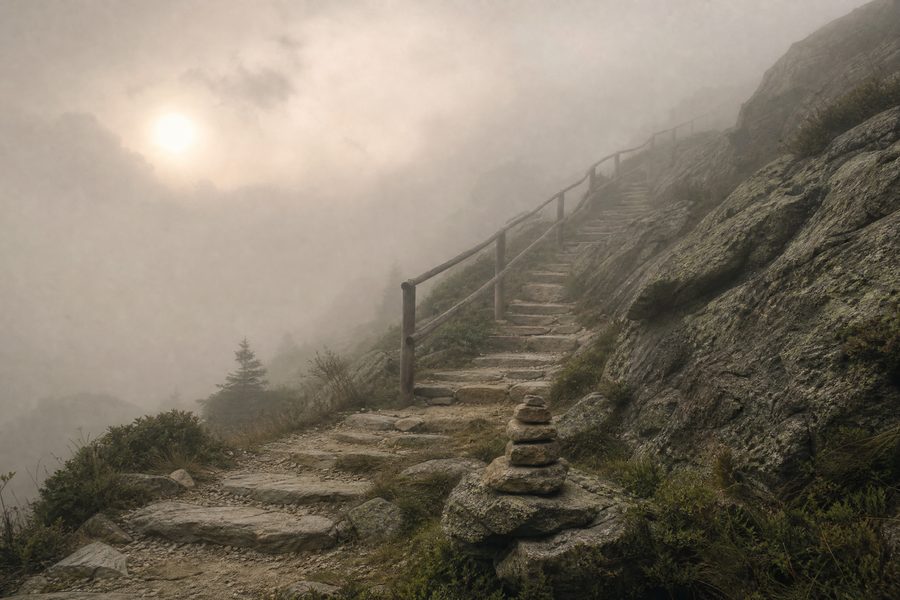
The path in the photograph above the essay is not difficult. Any reasonably fit person can walk it. It is simply long, and if you have ninety minutes and it takes three hours, you will turn back and describe it, not entirely wrongly, as too hard for you.
Recorded
Fifty-one logged attempts at a single encounter, seven hours of them, and a finished playthrough. No score is given, here or anywhere else in this journal.